
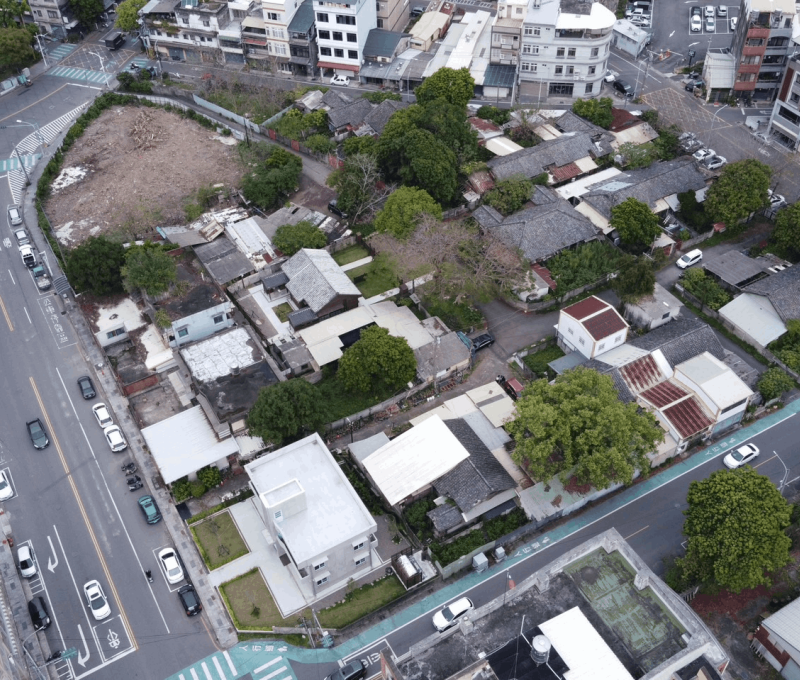
聚落發展史、使用變遷史 1930年代因應日本南進政策,臺灣總督府推動工業發展,竹東因鄰近山區富含木材、石油、天然氣、煤炭、矽砂、石灰石等天然資源,吸引許多新興工業設廠,成為新竹工業重鎮。 昭和十五(1940)年,日本商人平戶吉藏於竹東設立出張所,並在雞油林設立「植松木行竹東支店」,興建大型製材廠、貯木池、貯木場、事務所及員工宿舍等產業設施,積極砍伐天然原始林,以應日本軍方之需。 民國三十四(1945)年11月竹東林業由「臺灣行政長官公署農林處林務局」接收,並沿用「植松」之名繼續經營。次年,國民政府設置林業管理委員會,並正式接收日本人在臺灣公、民營的事業,以三組方式進行接收工作。植松在竹東的林業資產後改名為「竹東林場」,隨著竹東支線的修築,竹東成為林業發展的重鎮。 二戰後至民國六十年代間,為充實國庫財源,臺灣的山林資源有計畫地進行開採,隨著工商業逐漸發展後,民間森林保育意識的抬頭,民國六十二(1973)年行政院頒行「台灣林業經營改革方案」,伐木量逐年減少。至民國七十(1981)年左右,因山林資源漸稀與政府的禁伐令,林業製材的產業日漸沒落,相關地景也逐漸荒廢、拆毀而消失。民國七十九(1990)年後,竹東林場停止生產,土地逐漸轉為都市計畫公共設施用地,原有的空間亦大幅轉變為其他使用。 聚落整體規模及特色 「竹東林場建築群」包括「林業展示館(竹東林場製材廠貯木場辦公室)」、東林路148巷宿舍群、長安路53巷宿舍群,位處竹東車站前,鄰近圓環與竹東鎮公所,許多竹東鎮的政府機關皆設立於此,為竹東鎮行政的核心區。 竹東林場製材廠貯木場辦公室現為「林業展示館」。東林路148巷宿舍群共計40戶,是竹東林場宿舍區中保存範圍完整、且類型豐富而多樣的區域。集結了日治時期、戰後初期的多種宿舍風貌,包括沿中正路的戰後雙拼樓房宿舍,以及內側的日治與戰後日式雙拼木造宿舍。 長安路53巷宿舍群的巷弄蜿蜒,形成特有的紋理景觀。在靠近林森路的空曠處,尚存留一處防空洞設施,是當時防空之用的歷史見證。 聚落建築場所精神價值 「竹東林場建築群」為二戰後六大林場中北部僅存相關辦公與宿舍設施之案例,具其重 要性。此建築群見證林業與都市發展歷史,其保有巷弄紋理的整體景觀、展現了多元型態的宿舍單元,尚存當時宿舍區內的「原醫務室」、「原招待所」等服務設施,且建築群鄰近市中心,具有活化竹東區域發展之潛力。 資料來源:竹東林場宿舍群文化資產價值評估報告委託案成果報告書
History of Settlement Development and Usage Changes: In the 1930s, in response to Japan's southward expansion policy, the Taiwan Governor-General's Office promoted industrial development. Zhudong, due to its proximity to mountainous areas rich in natural resources such as timber, oil, natural gas, coal, silica sand, and limestone, attracted many emerging industries to set up factories, becoming an important industrial town in Hsinchu. In 1940, Japanese businessman Hirado Kichizo established a branch office in Zhudong and set up the "Zhudong Branch of Zhisong Timber Company" in Jiyoulin. He built large-scale lumber mills, timber storage ponds, timber yards, offices, and employee dormitories, and actively cut down natural virgin forests to meet the needs of the Japanese military. In November 1945, the forestry industry in Zhudong was taken over by the Forestry Bureau of the Agriculture and Forestry Department of the Taiwan Executive Yuan, and continued to operate under the name "Zhisong". The following year, the Nationalist government established the Forestry Management Committee and formally took over the public and private enterprises owned by Japanese in Taiwan, carrying out the takeover work in three groups. The forestry assets of Zhisong in Zhudong were later renamed "Zhudong Forest Farm." With the construction of the Zhudong branch line, Zhudong became an important center for forestry development. From the post-World War II period to the 1960s, in order to replenish the national treasury, Taiwan's mountain forest resources were systematically exploited. With the gradual development of industry and commerce and the rise of public awareness of forest conservation, the Executive Yuan issued the "Taiwan Forestry Management Reform Plan" in 1973, and the amount of logging decreased year by year. By around 1981, due to the scarcity of mountain forest resources and the government's logging ban, the forestry timber industry gradually declined, and the related landscapes were gradually abandoned, demolished, and disappeared. After 1990, the Zhudong Forest Farm ceased production, and the land was gradually converted into urban planning public facilities land, and the original space was also largely converted to other uses. The Zhudong Forest Farm Architectural Complex comprises the Forestry Exhibition Hall (formerly the Zhudong Forest Farm Lumber Mill Office), the dormitory complex on Lane 148, Donglin Road, and the dormitory complex on Lane 53, Chang'an Road. Located in front of Zhudong Station, near the roundabout and the Zhudong Township Office, it was the core administrative area of Zhudong Township, housing many government offices. The former Zhudong Forest Farm Lumber Mill Office now houses the Forestry Exhibition Hall. The dormitory complex on Lane 148, Donglin Road, with 40 units, is the best-preserved and most diverse dormitory area in the Zhudong Forest Farm. It showcases various dormitory styles from the Japanese occupation period and the early postwar period, including postwar duplex dormitories along Zhongzheng Road and Japanese-style duplex wooden dormitories from the Japanese occupation and postwar period. The winding lanes of the dormitory complex on Lane 53, Chang'an Road, create a unique landscape. Near Linsen Road, an air-raid shelter remains, a historical testament to its use for air defense. The Zhudong Forest Farm Architectural Complex holds significant importance as it is the only remaining example of related office and dormitory facilities in northern China among the six major forest farms established after World War II. This complex bears witness to the history of forestry and urban development. It preserves the overall landscape with its characteristic alleyway textures, showcases diverse dormitory units, and still retains service facilities such as the original medical clinic and guesthouse. Furthermore, its proximity to the city center gives the complex the potential to revitalize the Zhudong area. (Source: Zhudong Forest Farm Dormitory Complex Cultural Asset Valuation Report - Commissioned Project Outcome Report)

數位走讀