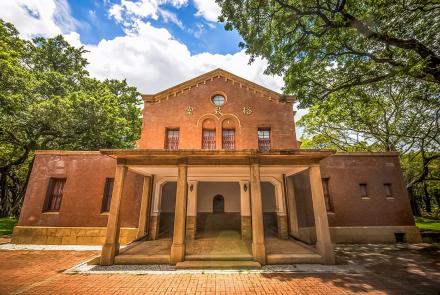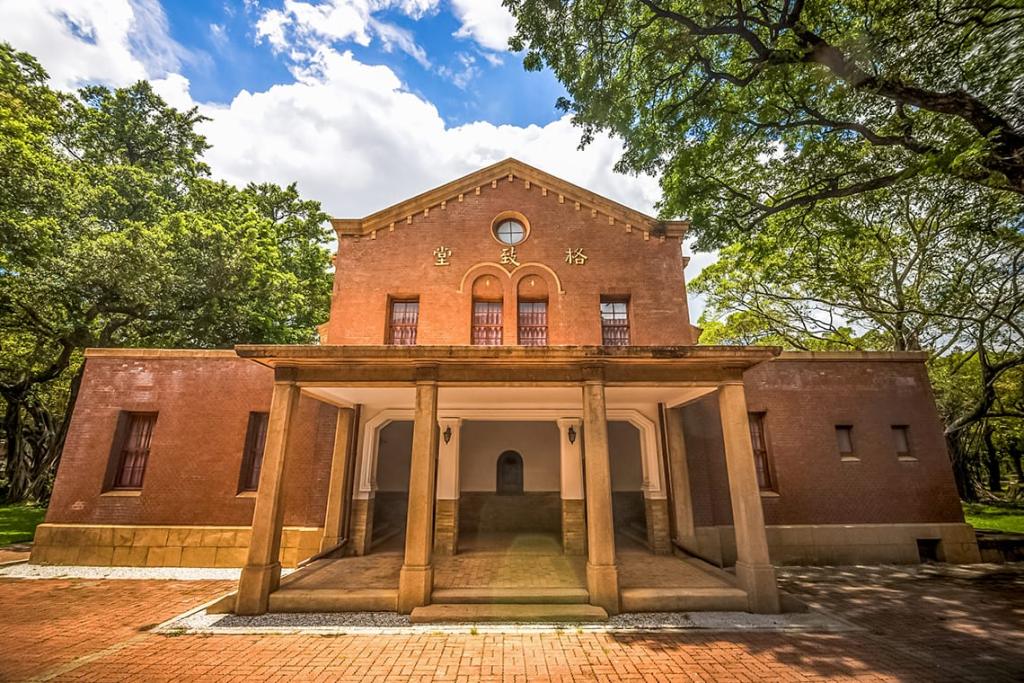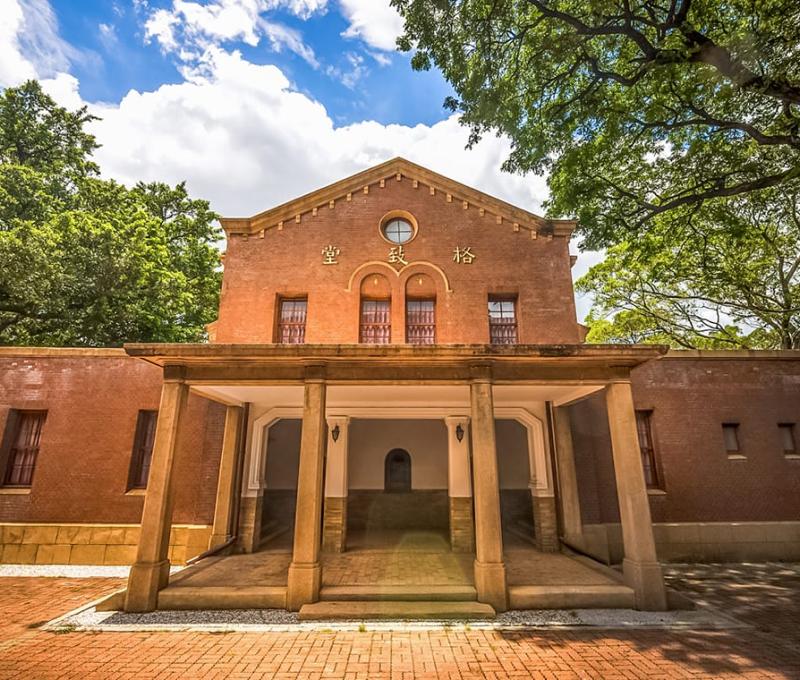
Gezhi Hall, originally named the Lecture Hall, was completed in Showa 9 (1934). The quaint building was historically used as a gathering place, designed with a simple and elegant style, featuring a harmonious color scheme of red-brown facing tiles and yellow-washed stone. Using "scratch tile" with their red, uneven surfaces was a sophisticated touch of the time. For ventilation, Gezhi Hall employs "Oeil-de-boeuf windows" at the top, named for their resemblance to a bull's eye. Below the roof, a series of protruding blocks are arranged in order along the edge of the roof, resembling the simplified "Lombard band" ordinary in Romanesque architecture. At the entrance, looking up, one can see a "Doric column" modeled after medieval Romanesque architecture. After the war, Gechi Hall was used as a student examination venue. Every Friday, students from the College of Engineering and Science would take their common subjects in Gechi Hall. Due to the high difficulty of the exams and the near impossibility of achieving high scores, Gechi Hall became known as the "slaughterhouse" by the students.